This Land Is Your Land, This Land Is My Land
November 17, 2010 § Leave a comment
 I’m taking a US Environmental History course this semester to fulfill my upper-level social science credit — it sounded boring [what could there possibly be to talk about? Changes in climate?] but I would do anything to avoid taking a political science or economics class.
Once again proving that my assumptions are almost always incorrect, this class has taught me more crucial information than any other gen-ed I’ve taken. It is, in short, a study of how humans relate to their environment and vice versa.
When you look out at a typical American landscape, you see grass, trees, and a clear expanse of sky. The suburbs in which I’ve grown up, at least, differ drastically from the hazy pollution of urban China, and I’ve always consumed the clean air and water of America with confidence.
Yet I’ve never seen the ecological battle that occurs every day on this continent. We’ve learned that the Dust Bowl of the 1930s, of which I had only barely heard about in elementary school, was not a freak incident of nature but a result of massive erosion due to poor farming tactics that stripped the land of its natural vegetation. During the beginning of America’s colonization, flocks of birds numerous enough to darken the sky were hunted mercilessly for sport; dams and overfishing have cut off many fish from their natural routes between hatching and developing, not to mention the endless invasive species transported to various bodies of water to keep some semblance of life. The earth is struggling around us.
Our first lesson was about Native Americans. Most people, currently as well as in the history of our nation, have had a romanticized vision of the nomadic American Indian who only kills what he needs and uses every part of a bison, demonstrating a spiritual connection to nature and as small of an environmental footprint as possible. But this is inaccurate, a stereotype, not too dissimilar from the “straight-A student” ones that Asian Americans face today.
When colonists first set foot in America, they stepped into a landscape that had already been transformed by the people living there. Native Americans regularly set brush fires to clear the plains of shrubs, and they also had bison jumps, which were basically cliffs from which they drove herds and herds of bison to their deaths. It was certainly a wasteful way to hunt, since there was no way to preserve the piles of carcasses, but it’s an intelligent strategy much safer than chasing a bison with a spear. The point here is historical agency — our idealized notion of Native Americans robs them of the power to change their environment, which they inarguably did because they were reasoning, capable people.
But the breadth of environmental change caused by non-Native Americans has been so much more devastating.
For the past week, we’ve been watching a documentary called Blue Vinyl, created by Judith Helfand. The film documents the consequences of PVC plastic, primarily in the form of vinyl siding used on millions of houses across America.
A clip:
In summary, this is what I learned:
1. PVC, a cheap and efficient form of plastic, is everywhere from the side of your house to your pipes and toys and other plastic things.
2. PVC is made from vinyl chloride, the life cycle of which makes it one of the most hazardous consumer products in existence due to the toxins that are released when PVC is produced and disposed of.
3. Burning PVC, which is the most common and easiest way to dispose of the product, produces toxic fumes.
4. These toxic fumes are dioxin, which causes tumors in those exposed to vinyl chloride. Factory workers as well as those who live near factories develop angiosarcoma of the liver, a rare form of cancer.
5. European vinyl chloride manufacturers actually signed a pact of secrecy with American companies not to publish scientific reports that showed correlations between vinyl chloride exposure and angiosarcoma.
6. When the documentary was being made, PVC executives in Venice were being charged for manslaughter due to deaths of their factory workers. The thing is…they simply don’t care, and were all acquitted by the jury.
It’s hard to fight vinyl. The plastic is cheap, durable and ubiquitous. Realistically, most people can’t afford to build their houses with another material. Blue Vinyl highlighted the fact that vinyl corporations donate millions of dollars in products to Habitat For Humanity in order to provide families with affordable housing.
But cheap consumer prices don’t reflect the cost to the environment. As Americans, we can’t escape the capitalist frame of reference: our minds are always thinking in terms of cost-benefit analysis. Recycling vinyl is immensely expensive, so is it worth the effort? Is it worth it if the trade-off is the release of cancerous chemicals into the environment?
I have a friend who is adamantly against recycling, something about the effort being more expensive than simply throwing the materials away. But when you pit monetary cost against ecological cost, is it really okay for the environment to come out on bottom?
Vinyl is worrisome, but there are precedents of hazardous materials becoming obsolete. Before 1900, asbestos was a popular building material, but after discoveries just a few decades ago that exposure led to diseases such as cancer, governments began passing laws to phase the material out of consumer products. It’s possible for us as consumers to take control of what is sold to us and how it might harm our world; it starts with educating yourself.
Tangled Tangent
October 8, 2010 § 3 Comments
O M G DISNEY IS FINALLY DOING RAPUNZEL!!!!!!! MY FAVORITE FAIRY TALE!
Somehow my favorite princesses always seem to be the most useless [ie. Sleeping Beauty], but they’re the prettiest, trust me. As a child, I had a picture book of the Rapunzel story [I can’t find the specific one anywhere online grr], the illustrations of which were really attractive. Searching for it on Amazon & Google is helping me revisit my love of children’s books, though; the art styles are so creative and diverse and wonderful!
I think it also helped develop this thing I have for blonds…shiny platinum blonde hair is very eye-catching for me. Here are a few of my favorites, all of whom I don’t [or wouldn’t] like as much with another hair color:
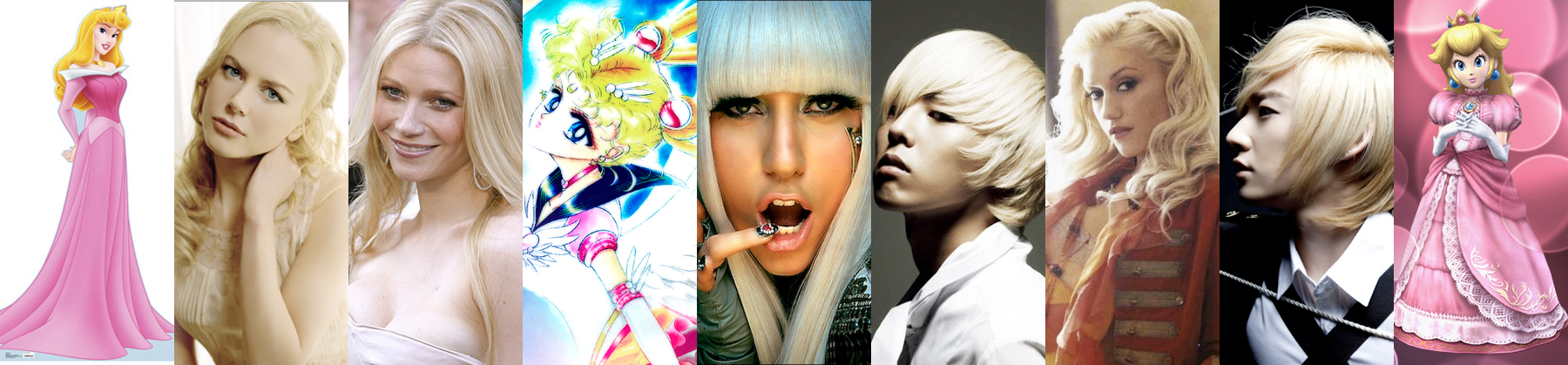 L-R: Princess Aurora, Nicole Kidman, Gwyneth Paltrow, Sailor Moon, Lady Gaga, G-Dragon, Gwen Stefani, Kevin Woo, Princess Peach [OMG forgot Carrie Underwood]
Anyway, back to the actual movie trailer.
I’m a little disappointed to see that the film seems to center around the male hero instead of the woman trapped in the tower, but the movie description gives them equal weight, so we’ll have to see. The animation looks so smooth that it didn’t even register as non-2D at first. Release date is November 24!
I Love It When A Plan Comes Together
June 15, 2010 § Leave a comment

Jealous. So jealous.
At home, I would rarely pay $7US for a movie ticket, but in Hong Kong, shelling out $50HK for a student ticket seems perfectly reasonable. Why does this happen? Kaiti & I spontaneously saw The A-Team today, which was a great idea except THE PERSON BEHIND ME KEPT KICKING MY SEAT. I was ready to bite his/her feet off in the middle of the film. Anyway, overall I enjoyed it greatly and had rather few remarks.
1. This is a much better film than Prince of Persia. It’s a higher quality of action/comedy, and though the CGI isn’t amazing, it at least didn’t look pathetic.
2.The plot is complicated enough to catch your attention, yet simple enough not to get in the way.
3. Very importantly, the romance is kept to a bare minimum, meaning the director only employs it for significantly necessary reasons. THANKS BE TO JOE CARNAHAN for this.
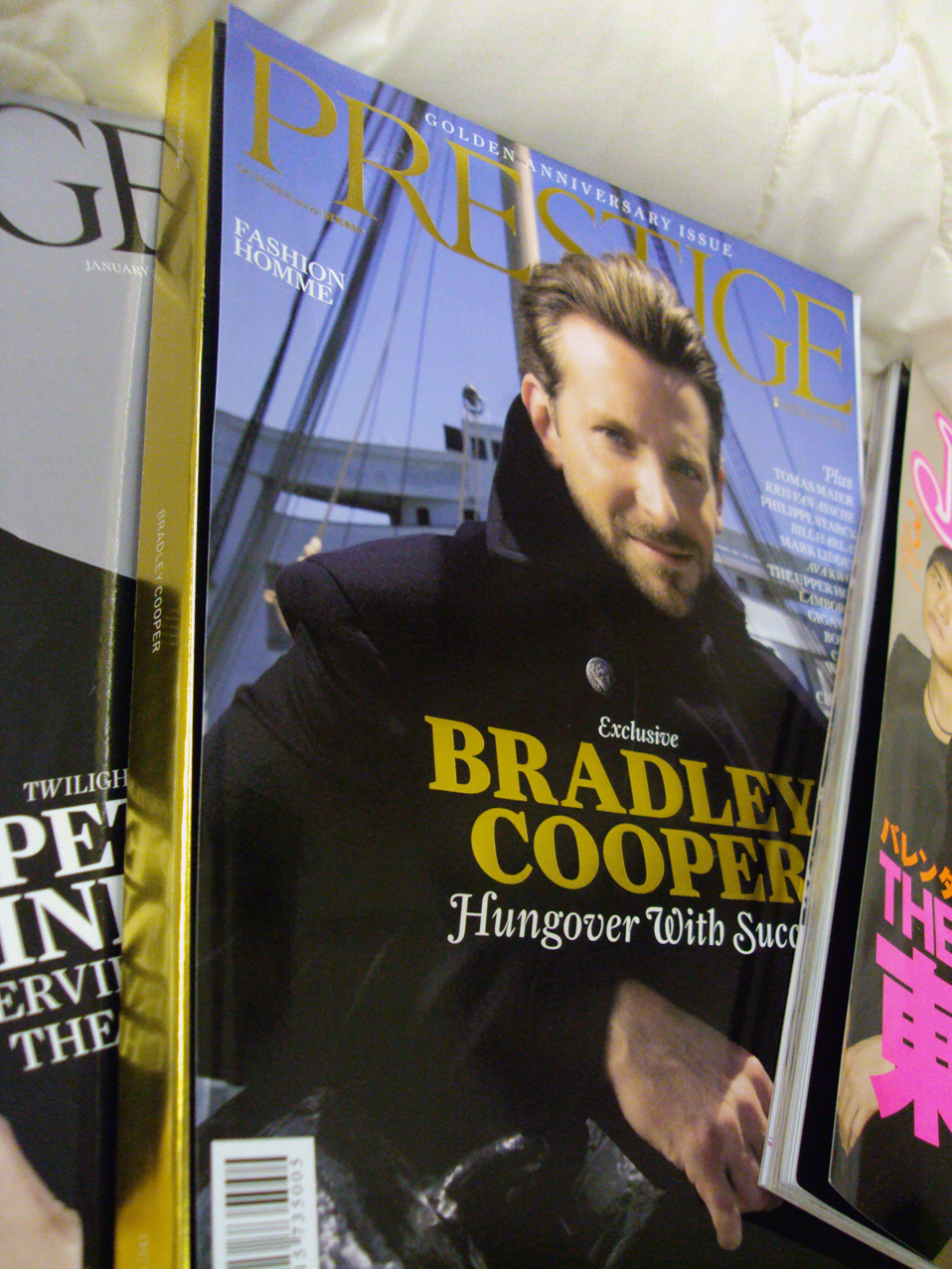
4. I didn’t think Bradley Cooper was that goodlooking in The Hangover, nor when he was featured in our magazine, but I sure like him after The A-Team [PECS!]. He and Patrick Wilson have such nice blue eyes. There are so many goodlooking men in this movie :D
5. Jon Hamm makes an appearance at the end! I’m not sure why I got so excited about this…I’ve never seen Mad Men. But it does add to the attractive man count.
6. For the whole film, Murdock reminded me of a thinner, crazier Luke Wilson.
7. The tough-black-man-afraid-of-flying theme was hilarious, but also a bit ridiculous. I mean…really? Really?
8. Jessica Biel [hot] has an Asian sidekick! I’m not sure he ever spoke…but I noticed him.
9. Pretty much the only complaint I have is from the beginning of the film: I never understood how Hannibal managed to fight off those angry dogs. WHY ISN’T THIS EXPLAINED???
10. Here are the Ghandi quotations, in case anyone is interested:
Victory attained by violence is tantamount to a defeat, for it is momentary.
It is better to be violent, if there is violence in our hearts, than to put on the cloak of nonviolence to cover impotence.
Until Lambs Become Lions
June 6, 2010 § 1 Comment
 This is going to be a short one because I actually didn’t really want to see Robin Hood, but we were already in the theater with no other options and at least Cate Blanchett [probably my favorite actress?] was a supporting character. I’m just not a big fan of Russell Crowe [not into the old, grizzly type], and as Kathy said, the trailer makes the movie look bland. But it wasn’t! So read on:
1. Robin Hood is raw, gritty even. For what it lacks in polish, it makes up in quality, and even though there was nobody to ogle, I’d have to say this is much better than Prince of Persia. The budget was probably a lot higher too…
2. The romance is slow & meaningful, and it was not disgusting to watch them kiss…which of course they did.
3. Cate Blanchett makes a much better couple with Russell Crowe than Brad Pitt. They actually made my heart thump, and I’m always dazzled by Cate’s beauty; she has a face worth going to war for [only relevant because someone said yesterday that Diane Kruger was not worthy to play Helen of Troy].
4. I’m pretty tired of Mark Strong [aka evil-looking bald man] playing baddies. He should switch to comedy or drama, spice things up a bit.
5. This film made me kind of miss learning French. But I could understand at least half of what they said…
6. Why do both kings wear colored contacts? This bothered me a lot.
7. The battle scenery is amazing; horses and metal flying, but at the same time I’m reminded of the terrible waste & destruction of life.
8. I’VE ALWAYS LOVED ARCHERS THEY ARE SOOOOO COOOOOL!!!!!!
9. When I was thinking about the movie a few hours later, I honestly couldn’t remember how it ended. Then I finally recalled that the end was more like a beginning, and there wasn’t much resolution but it was a good setup for a sequel … if they ever make one, that is.
 auradis